
Mapped category
mapped-category renders a select. Choosing an option writes that option’s mapping into other
fields of the same form. Use it when one human decision sets several model inputs at once, such as
a sampling preset that fixes a rate and a window. If each option only switches one 0/1 column,
use onehot-category instead.
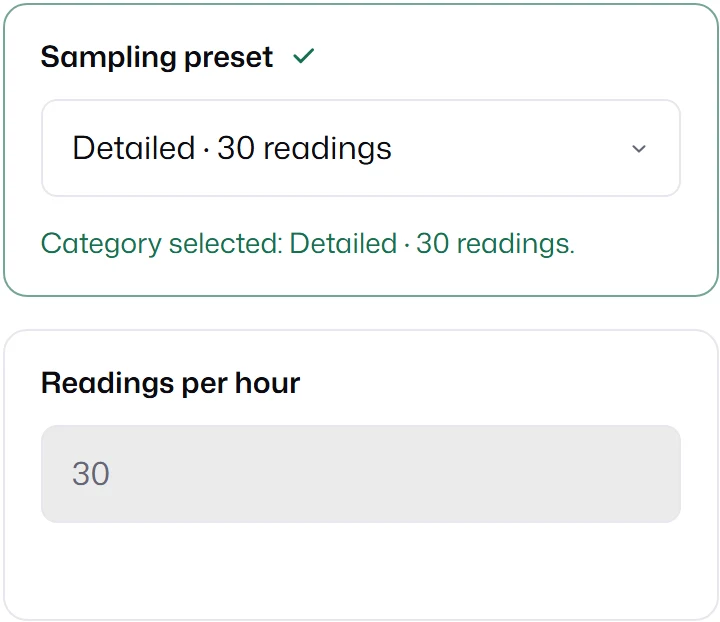
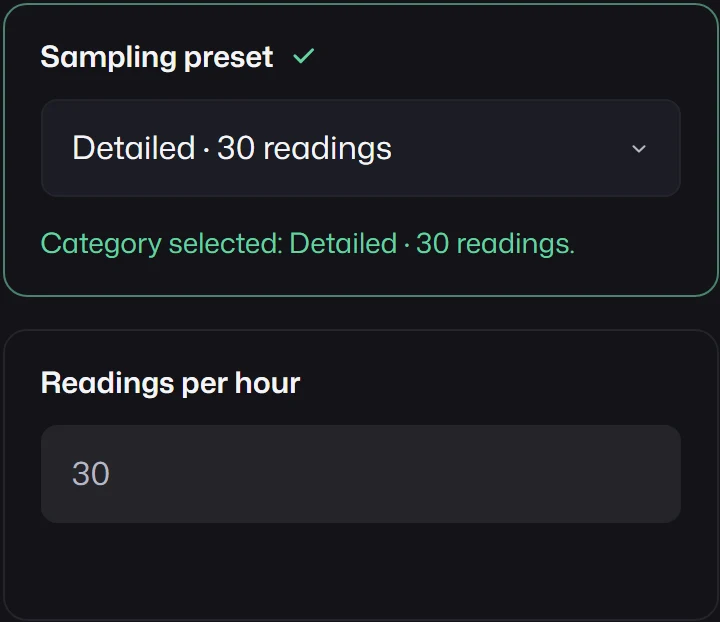
{ id: "mapped-category", kind: "mapped-category", label: "Sampling preset", defaultValue: "detailed", options: [ { label: "Quick · 10 readings", value: "quick", mapping: { readings: 10 }, }, { label: "Detailed · 30 readings", value: "detailed", mapping: { readings: 30 }, }, ],},{ id: "readings", kind: "number", label: "Readings per hour", defaultValue: 30, readOnly: true,}Selecting Detailed wrote 30 into the read-only readings field below it. The preset itself is
a UI choice; the values the model needs live in the target fields.
How values reach the model
Section titled “How values reach the model”The master field is excluded from submission by default (includeInSubmission: false). The
targets submit through their own mappedTo, exactly like fields the user edits:
const schema = { fields: [ { id: "sampling", kind: "mapped-category", label: "Sampling preset", required: true, options: [ { label: "Quick", value: "quick", mapping: { "readings-per-hour": 10, "window-minutes": 15 } }, { label: "Detailed", value: "detailed", mapping: { "readings-per-hour": 30, "window-minutes": 60 } }, ], }, { id: "readings-per-hour", kind: "number", label: "Readings per hour", readOnly: true, mappedTo: "rate" }, { id: "window-minutes", kind: "number", label: "Window", unit: "min", readOnly: true, mappedTo: "window" }, ],};Choosing Detailed submits { rate: 30, window: 60 }. Set includeInSubmission: true and a
mappedTo on the master field only when the model also needs the preset name.
Visible or hidden targets
Section titled “Visible or hidden targets”- Read-only targets, as above, show people what the preset did and are submitted normally.
- Hidden targets keep the form compact. Hidden fields are inactive and omitted by default, so
give each one
inactiveFieldPolicy: "include":
{ id: "readings-per-hour", kind: "number", label: "Readings per hour", hidden: true, inactiveFieldPolicy: "include", mappedTo: "rate" }Options
Section titled “Options”Every option is an object; plain strings are not accepted.
| Property | Type | Meaning |
|---|---|---|
label |
string |
Text in the select. |
value |
string |
The master field’s value. |
mapping |
Record<string, unknown> |
Target field ids and the values to write into them. |
- Targets are field ids. Mapping keys use exact runtime ids, and every key must name a field in the schema; an unknown target fails schema normalization.
- One direction. Changing the master writes the targets. Editing a target does not change the master, and nothing is written when the master becomes empty.
- Normal values. Written values go through the target’s normalization and validation. An invalid value shows as an error on a visible target and blocks submission. Hidden targets skip validation, so keep their mapped values valid for the target kind.
- Any compatible kind. A target can be any field kind that accepts the value, such as a hidden
categorywhoseoptionsinclude it. - Code writes too.
form.setValues({ sampling: "quick" })updates the targets the same way. - No chains. Do not map one
mapped-categoryinto another.
Related
Section titled “Related”onehot-categoryfor strict0/1encodings without target fields.seriesaggregations for features computed from entered data.